
TESOL COURSE

THAILAND

learn earn travel in thailand

American TESOL Institute - TESOL Course in Thailand
Special Thai Projects
Links For Special Project
Quick Links

Download Brochure
Chiang Mai
Phuket

Home | About us | Why ATI | Accreditation | Job Placement | FAQ | Apply

Special Thai Project - TESOL Course in Chiang Mai, Phuket - Thailand

WELCOME TO TESOL COURSE THAILAND

FAQs -

Contract All | Expand All

Will I be able to save money or pay off student loans while working with in this project in Thailand?

Managing a comfortable living off a salary of 30,000 baht/month isn’t a far-fetched idea in Thailand. Besides fulfilling the basic needs, it is also possible to pay off loans out if this salary package. But the fund management is largely influenced by your standard of living. Adapting to the Thai lifestyle, weather, food guarantees a cheap living. However, if you continue to cling on to your western habits and needs, it would sit tight on your pocket. Television, stereo, DVD, personal computer, 24 hour air conditioning mean recurring charges. Therefore, if money is the primary concern in your teaching career you should rather look forward to countries like Korea, Taiwan, or Japan who pays much higher when compared to Thailand.

How much money will I need to build a set up and to live until I start receiving my salary?

The amount is variable, depending upon your lifestyle and adaptability. You will probably need accommodation for a couple of days before the TESOL program begins or in between the end of the TESOL program and the beginning of your teaching assignment. Bangkok displays an array of living options ranging from a truly basic 200 baht/night to a steeply priced 6000 baht/night. To choose a decent place, you will probably need to shell off 500-800 baht/month.


As salaries are disbursed at the end of the first month of teaching, it is wise to keep a provision of 30,000 – 45,000 baht (approximately $1000-$1500) for the first 6 weeks. PLUS and CIRRUS certified bank cards are used across all Thai ATMs.

What is it like to teach English in a Thai government school and Private schools?

Working in Thai schools is undoubtedly a different experience, compared to a more professional approach in western schools.


Benefits for a foreign teacher in Thai-schools -

  1. Your presence in the school and community is accepted with enthusiasm and pleasure.

  2. It is possible to develop favorable social and professional contacts

  3. Sweeping appreciation from the students.

  4. Opportunity to one with the Thai community

  5. Be better enlightened about Thai culture and living.

  6. The TEFL trained teacher will need to be an expert in the basic conversational skills like speaking and listening (you don’t have to be a grammar expert, although grammar knowledge doesn't hurt).

  7. Weekend work is nominal

  8. Enjoy a long list of holidays including semester breaks when even regular classes are replaced by entertaining functions and activities.

Impediments for a foreign teacher in Thai-schools

  1. A grossly populated class of 40-45 students.

  2. Fixed school timing from 8am – 4:30pm from Monday to Friday.

  3. Frequent communication errors between the teacher and the school, which need to be resolved.

  4. Inadequate teaching resources.

  5. Generally a low salary package is offered.

  6. Need to get involved in extra-curricular and administrative activities like staff meeting, morning assembly, gate greeting etc. which are not always warmly accepted by foreign teachers.

Do I have a choice of city and school?

ATI tries its best to make both the counters happy. But, it is usually difficult to perfectly match the school and the teacher, satisfying the needs and conditions of both sides. Schools often set criterions related to age, sex, experience, behavior, looks of the teachers and the parameters vary from school to school. Moreover, higher qualification fetches finer options. Therefore, teachers are recommended to be flexible while stating their preferences and supporting reasons. The sooner that you can commit, the better your chances will be of acquiring a position that you desire.

The process of acquiring a Non-Immigrant B Visa and Work Permit. The documents required.

A. Documents to furnish -

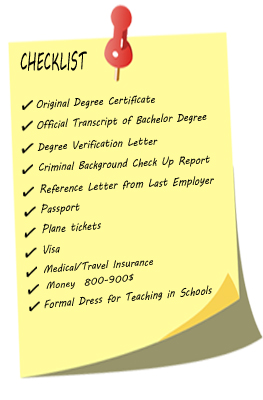
  • Degrees, transcripts, certificates, diplomas, awards regardless of their relevance to teaching (both original and copies).

  • It is always better to have more paperwork down, more seals and signatures attached.

  • Rest of the documents like Health Certificate, photographs, passport pages will be provided and arranged by ATI in Thailand

B. The process to be followed -

It is a long drawn, complicated process involving a lot of bureaucratic intervention. Though innumerable proceedings are involved, the basic steps can be traced as –

  • To acquire a 3-month Non-Immigrant B Visa

  • Apply for Work Permit at the Provincial Labor Office to match the Visa

  • Work Permit or the Receipt of the same to be taken to Immigration, applying for Visa extension

  • Carry the new Visa to the Provincial Labor Office, applying for extension on Work Permit

It is allowed to enter Thailand on a free 30-day transit Visa. The 3-month Non-Immigrant B Visa is the maximum that can be arranged for, prior to the teacher’s departure from the home country. In case of unavailability or delay, the teachers need to go on Visa Run to Laos, before they embark on their teaching assignments, to obtain a proper Visa.

What are the students and schools like?

The schools, all over the major cities of Thailand, where the teachers are placed by ATI generally sports plush campuses. They are expected to have a commendable resource base with classrooms provided with blackboard or whiteboard, audio-visual teaching aids like TVs, CD/DVD players, OHPs etc. Classrooms in government schools are often fitted with A/Cs. Computers with net connectivity are thankfully constant feature across most Thai schools. It is possible to grab cheap grub at the school cafeterias. However, the schools in remote rural areas are less privileged but have the potential to provide a challenging and enriching teaching experience.

Thai students are characteristically respectful towards teachers and are rarely rude or malicious. In smaller cities and towns, this respect transforms to awe and reverence to begin with. Thai children tend to shy off from foreign teachers and can be pulled back only by creating an atmosphere of warmth and friendliness.

How may I earn extra during my free time?

Private tutoring is a good way of earning extra and easy bucks in Thailand, for the foreign teachers. A good-natured, friendly and amiable teacher with active presence in the community is the most viable to receive private-teaching offers. One can also work at English Camps on weekends or on holidays.


FAQ Country

What happens after I land in Phuket Bangkok?

ATI will arrange to pick you up from the airport at a fixed time intimated to you prior your arrival, and transfer you to the place of accommodation. Everything is kept arranged in advance. The Program starts the very next day.

Do I need inoculations to enter Thailand?

Thailand is predominantly safe and healthy, playing host to thousands of tourists round the year. Most of them visit without any sort of vaccinations and don't suffer any dire consequences in the country famed for its burgeoning Medical Tourism.

Citizens of US, UK, Australia and other industrialized nations do not require inoculations. Precaution can be taken for hepatitis, typhoid, tetanus and polio though chances of infection are generally nil. Those planning to stay in the rural areas can carry Malaria pills with doctor’s advice, for use in emergency. Malaria isn’t a threat at all in the cities or beach resorts.

What should I pack for a trip to Thailand?

Like any other tropical country, Thailand is mostly hot and humid. Cotton weaves are best suited for such climate. However, the nights during the cool season (November to February) tends to get chilly in North.

Teachers in Thai society are highly esteemed. Thus professional attire for even the foreign teachers should strictly conform to the Thai culture of dressing. Men, while in schools, are expected to wear formal trousers, shirts and closed shoes while ladies should necessary keep their shoulders and knees covered.

Beach wear is perfect on the sandy stretches. But elsewhere, the Thais prefer to respect those who are not under-dressed or clad in revealing clothes. Staying decently clothed is a reflection of Thai culture.

Western clothing the sizes small, medium and large is available in Thailand at a cheap rate. A T-shirt can be as lowly tagged as $2.50. But it is difficult to lay your hands on the size XL or larger. Trial is suggested before every buy. Generally something that says XL is much smaller and there isn't any standardization. Large sized shoes and sandals are difficult to find.

Why do people visit Thailand?

Thailand attracts with its eclectic blend of nature and culture. Its oriental exoticism has flourished further with the touch of contemporaneity. Travelers in Thailand are captivated by its beaches, its historical past, its bustling markets, architectures and infrastructures and culinary delights. The country is a treasure trove of endless offerings.

What is the exchange rate and should I get baht before I go to Thailand?

Currency exchange is suggested only after arriving in Thailand. Exchange at the airport does not provide a rate comparable to the foreign banks but can save you till you come across an official currency exchange certified by a Thai Bank. The major cities are dotted with exchange booths. Exchanging at hotels is the last option you should tap as they eat up at least 10% of your fund. Small changes come handy while paying of the taxis.

What customs and manners should I be aware of?

Thai society is strongly particular about certain norms and codes of conduct, which even a foreign teacher is expected to follow.

  • Primarily, one’s behaviour should express respect towards Thai Royalty, Thai people, Buddhism and the country.

  • Greeting through the posture of ‘Wai’ (putting two palms together as if praying) and also responding to a ‘Wai’ is appreciated. However, the Thais are considerate and tolerant and prefer to overlook unintended mistakes done by foreign visitors.

  • Shoes need to be left outside, while entering a Thai house, temple or school.

  • It is considered extremely impolite and improper to point or show the bottom of your feet towards any person. It can happen when you cross your legs, sit on the floor or rest your feet on something. Pointing fingers at someone should also be replaced with gestures with your hand palm up, if you need to indicate anybody in particular.

  • Head being the highest part of the body commands ultimate respect in Thai society; thus nobody should be touched on the head.

  • Public expression of anger, agitation, or jest is not welcome in Thai society where the people are necessarily soft spoken. A mellowed and modest attitude is more acceptable.

  • Kissing publicly is dismissed in Thai society.

  • All should dress appropriately and formally for the occasion and formal or official venues in Thai community.

Is it safe to leave valuables like tickets or laptops in the hotel room?

Thailand embodies safety and security. Laptops can be left at the reception and passport in the safety deposit boxes, unflinchingly, if you don’t feel like carrying them. However, the basic safety measures like locking your luggage, bolting the door at night, taking care of the room keys and wallet and credit cards should not be ruled out altogether.

Is tipping a common practice?

Tourists often indulge in tipping at bars, restaurants and in hotels. Rounding off taxi fares or leaving loose change from a restaurant bill is also common. But tipping is not consciously practiced in Thailand. The permissible range for paying tips is between 0-40 baht.

Are there Internet cafes in Thailand?

Internet Cafes are found in plenty in Thailand. The leading cities are dotted with net-hubs with varying prices. In areas frequented by tourists, the rate can be a baht per minute. However, around academic institutions, the rate can dip as low as 10 baht per hour. 

Is there a safe, secure place to store my luggage?

In order to avoid inconvenience, luggage can be stacked in your hotel and valuables under separate and special care there itself, against the payment of a nominal charge. Airport can also be an alternative. Chubb Aviation (owned by Guardair) offers what is reported to be secure luggage storage and they are open 24 hours a day. In Bangkok, they have outlets in both the domestic and international terminals. They can also be found at the Chiang Mai, Phuket and Hat Yai airports. The fee is 90 baht per day for up to three months.

Are credit cards accepted in Thailand?

Thailand is well identified as shopper’s paradise. International tourists are usually on buying spree while exploring Thailand. The malls and the big stores accept credit cards like Visa, MasterCard, American Express and Diners Club for purchases. Credit cards can also be used for cash withdrawal from ATM and at currency exchange locations. However, cards are not that popular at smaller markets like the Weekend Market.

How much will I need to spend per day to survive?

Thailand offers a flexible range of living options for the travelers. An ideal allotment for daily- spending in Thailand that promises a decent room, 3 meals and covers certain amount of traveling cost as well should be around $20. This however would not be sufficient for more vigorous traveling.

What kind of food is available?

Thai cuisine is eclectic but primarily spicy. It is relished even by the most fastidious tongue for its aroma, taste and the rollicking blend of ingredients. Though western food is easily available all over Thailand, tourists prefer more to indulge in Thai delicacies. For those who are allergic to certain food items, it is important to scan the menu card in detail before placing the order. On special request, restaurants can also prepare Thai food, less spicy.

What if I need help from the police?

Thai Police are known to be helpful if approached with a polite and decent attitude. Never, ever yell, point at or try to strike a police officer. It is possible to contact the Tourist Police Office at telephone number 1155. In case you need to go the local police station, it is recommended to take a Tai speaker with you for better communication.

How can I have money sent to me in Thailand?

Western Union and wire transfer are the two leading modes of receiving fund in Thailand from outside the country. Western Union renders prompt service against a hefty charge. Wire transfer at the foreign exchange sections of major banks on the other hand takes more time, depending on the country that is disbursing the fund. The Bangkok Bank in Thailand is the best in the trade. A passport is the basic requirement to process money transfer.

Is it safe traveling alone in Thailand?

Solitary traveling is generally safe in Thailand; though traveling in a group is always safer. Before setting out alone, it is good to take precautions like carrying copies of all important documents, keeping in touch with family and friends overseas. A foreign traveler should never hesitate to ask for local assistance as Thais are always a helpful community.

What are Thailand’s visa requirements?

Tourist traveling to Thailand can enter on two main visas:

  • A "visa free" stay of 30 days,

  • A tourist visa valid for two months.

Both the options are allowed extension for varying lengths, varying number of times and varying costs. The nearest Thai embassy or consulate or www.thaivisa.com is able to furnish you with related details that vary with varying nationalities. Work visas are generally the employers’ responsibility.


FAQ – Special Thai Project
The frequently asked questions regarding the Explore Thai Project are noted below. The answers should work towards your decision making.

Will I get to choose my own school and location?

It is not always feasible to provide you with a matching school and location as various contrasting factors are on play while finalizing a deal with a schools. However ATI always strives to offer you the best possible option.

Does the school and apartment have internet facilities?

Internet facility is usually available to teachers across all Thai schools. Cyber Cafes are strewed all over the major Thai cities helping you to stay conveniently connected.

How many holidays will I get in these 4 months?

An ESL teacher placed in Thailand by ATI is eligible for weekends and public holidays. But occasional visits are expected from you on event of some extra-curricular activities on Saturdays. Even on public holidays, a occasional coinciding school event might demand your presence in school.

Can I travel and see the country in these 4 months?

Thailand can flaunt its inter-city super connectivity and well paved roads. Therefore exploring the country isn’t grossly time or energy consuming, if planned well. The schools which are situated already in tourist locations gift you with the advantage of moving around and exploring the region after school hours.

Why this special program? How does ATI earn from this program?

American TESOL Institute is based on a spirit that is driven towards education. The objective of ATI is to revolutionize and at the same time imbibe progressive methods of learning a second language. ATI organize their special programs that cater to the need of native speakers who want to travel and teach in Thailand, at a very special price package. It is a mutual understanding between ATI and the schools where the schools pay the balance money to cover the full certification fee.

Is this course different from the normal 4 weeks TESOL course?

The Explore Thailand Project from ATI is a combination offer that gives you the best of theoretical and practical teachers training while preparing the skills within you. In terms of quality or course structure, the project is matches the in Class TESOL program. Only the time schedule varies a bit. Moreover, the project comes with the unique opportunity of gaining 4 months of invaluable classroom experience in a Thai school.

Do I have the chance to extend the contract? In that case will my salary increase?

The contract can be mutually extended with an expected salary hike.

Is there any dress code for the school?

Formal clothing is a must in Thai schools. Ladies are expected to cover their shoulders and knees. Men should wear collared shirts and formal trousers and closed shoes.

What about food? Does the school provide lunch on teaching days?

Most Thai schools do not provide their teachers with lunch. However, the school cafeterias are known to serve sumptuous meals at cheap rates.

Does the school take care of the safety and security of the teachers?

ATI takes good care of the fact the teachers are placed in safe and secured institutions.

Is this certificate recognized only in Thailand?

No this certificate is recognized all over the world and you can teach any were with this Internationally acclaimed (Check the affiliations) and recognize 120 hour TESOL certificate.

American TESOL Programs are accredited by USETTA

American TESOL Institute is state licensed in Baton Rouge, Louisiana, USA.

American TESOL Institute is a member of Central Florida TESOL Organization located in Orlando Florida.

American TESOL Institute is a Global ambassador school for iEARN ATI teachers receive iEARN membership.

American TESOL Institute is licensed under SAFEA

American TESOL Institute is a member of USDLA

American TESOL Institute is partnered with Interpark Communications and Talkbean. The world largest and most sophisticated online provider of online ESL training.

ATI is also a member of THAI TESOL. Its purposes are to strengthen English language education at all levels, to undertake research in the Teaching of English to Speakers of Other Languages, to offer scholarships, to disseminate information, and to cooperate in appropriate ways with other groups having similar aims and objectives.

American TESOL Institute is recognized by the Georgia Department of Education Office of Professional Learning.  

Map | Thai History | Thai Art | Thai Language | Learn Thai Language (new) | Survival Guide | Airfare | Banking | Basic Contract | Cost of Living | Culture | Currency Conversion | Deduction from Salary | General Facts | Hospitals for English Speakers | Medical Insurance | Passport | Degree | Qualification | Visa Rules | Sending Money Home | Students  |  Private Tuition | Things to Bring | Foreign Embassy

copyright: www.tesolcoursethailand.com