
|
Teaching in Thailand is a revered profession and the teachers
are looked up to with immense respect. And at par with this
honor it is recommended to embark upon a legal hassle free
teaching career with an appropriate visa and a fitting work
permit. The process of acquiring a visa in Thailand can be
complicated and gruesome but it guarantees to preserve your
dignity and peace of mind while you revel in a Thai aura.
Tourist Visa
This must be issued by the nearest Thai Embassy or Consulate,
wherever you apply from; be it America, UK, Australia, New
Zealand, South Africa or Canada. Usually it is a sixty-day
tourist visa with the option to extend by 30 days at an
Immigration office on the basis of the date of your return
ticket. Therefore it is advisable to buy your return ticket to
ensure your Thai visa. Once you have your tourist visa, you can
travel anywhere within the country.
A double entry tourist Visa would entitle you to the above, with
a further 60 day entry once you've left and returned (exit and
re-entry) to Thailand and the option to extend by a further 30
days. But you cannot work legally in Thailand on a tourist
visa!.
Visa on Arrival
Another option is to get a visa on your arrival at Thailand. The
visa will be handed to you as soon as you land in Thailand. Most
nationalities can receive 30 days on entry automatically with
the option (at the Immigration officers discretion) to extend by
10 days (OR SOMETIMES 14 DAYS) at an Immigration office. However
on October 1st 2006, Thai immigration has announced that one
could only have a maximum of three 30-days stamp followed by a
mandatory 90-days stay outside the country before the Visa is
allowed to bear another stamp. Alternatively, you can visit a
Thai Consulate abroad to get a ‘proper’ visa (tourist or
non-immigrant).
Non-immigrant B Visa
This type is generally obtained once you have found a suitable a
job in Thailand in order to apply for a work-permit valid for 3
months. To get one you are required to produce a whole stack of
paperwork including a letter of employment, an employment
contract, maybe a letter from your embassy (and there is even
talk of a security background check). You really need to call
the embassy or consulate ahead of time and find out EXACTLY what
they require if you want a non-immigrant B Visa. On entry you'll
receive 90 days of cover, with the option to extend by 10 days
at Immigration You can also obtain double entry Non-immigrant B
Visa (two entries of 90 days, the second entry is acquired by
exiting and re-entering the country). Multiple-entry
Non-immigrant B Visas are the best as they will give you just
under 15 months of cover in 90 day intervals. For a one year
period, whenever you enter Thailand with the Non-immigrant B
Visa you'll receive 90 days on entry. Generally most school
prefer you to be on a Non-immigrant B Visa if you wish to obtain
a work permit, although as mentioned before a Non-immigrant O
(spousal or dependants) Visa is in some ways interchangeable and
vice versa.
Non-immigrant O Visa
This is meant generally for people married to a Thai national or
with Thai children or dependants. This works in basically the
same way as a Non-immigrant B does. However, if you can show
funds in a Thai bank account (400,000 baht) or show sufficient
proof of local or overseas income to prove that you can support
your family, the immigration can indefinitely extend your Visa
for up to 12 months. A work permit can now be obtained on a
Non-immigration O Visa.
It is important to check all documents over and over again to
ensure a smooth visa run.
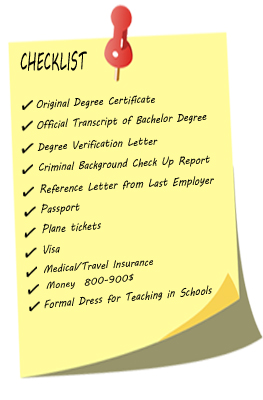
Loads of documents including
Original university transcripts;
Original university diploma/certificate;
Original TEFL/CELTA certificate;
Lots of photos (exact size and dress code to be confirmed).
Photos for your work permit need to be from the waist up and you
must be wearing business attire (suit jackets for guys and
girls).
Assorted sizes for the different permits (teacher’s license and
work permit
Health certificate from a Thai doctor
Border hop / Visa run to get a Non immigrant B visa
A border hop means to cross a neighboring border on a wheeled
vehicle and then coming straight back into Thailand again. This
is usually done to ‘activate’ a second or third entry on a
double or triple entry visa. The easiest and the most popular
from Thailand being the Thai / Malaysian border point at Pedang
Besar, the Thailand / Laos border point at Nong Khai and the
Thailand / Cambodia crossing at Aranya Pratheet.
As far as consulates are concerned, the most sorted after
choices are Penang (Malaysia), and Vientiane (Laos). Other
options include Singapore and Phnom Phen.
Schools almost rarely/never pay for a teacher to do a border hop
or consulate run. Your school needs to be on the unofficial
official school-list at the Consulate to be visited, in order to
avail a Non-immigrant Visa. However there are many ‘human
factors’ involved when you apply for a visa. Sitting with the
immigration officer across the table and carrying all the
necessary paperwork, you might end up getting a Non-Immigrant
Visa if you look clean and presentable.
The basics checkpoints before applying for a work permit
Ensure that the Company has a minimum of 2 Million Baht as paid
up registered capital per work permit. Make sure that the
capital is not registered only on paper.
The Company should have at least four employees per work permit
on its roles.
Be sure it is not a dubious company with an “office in its
pocket”. The company should be paying VAT and have the necessary
papers in order.
Work Permit
A legal teacher has a
i) Teacher's license (from the Thai Ministry of Education),
ii) A work permit (from the Thai Labor Department) and
iii) A one-year visa (from the Thai Immigration Dept).
The teacher first needs to have a Non-Immigrant Visa in order to
apply for a work permit. And subsequently a visa with an
extended duration up to one year is issued on the strength of
the work permit - a mandatory criterion for a foreign teaching
professional in Thailand. It is essential for the teacher to be
tolerant and helpful towards the school and provide them with
all the required documents in the process of gaining a work
permit.
The initial step towards getting a work permit is to arrange
for the ‘teachers license’ by providing:
A personal information document
About 12 one and a half inch photos,
About 12 two inch photos,
A current health certificate
Copies of your degree and other certificates (originals may be
requested along with transcripts)
Certified Thai translations of your degree and other
certificates
Copies of every page of your passport,
School director's license,
School principal's license,
Map of school,
Teaching schedule of teacher,
List of other work permit holders at the school,
A new blank teacher's license book (blue),
Form Sor Chor 10, Form Sor Chor 17, Form Ror 11.
And if you've had a license before, then you can add -
Ror 12, Sor Chor 19, Sor Chor 18, and
Your blue license book (not to be confused with the work permit
book)
All the above documents are signed and submitted to the Thai
Ministry of Education in quadruplicates. It takes about a week
from then to get the license. You take this, along with most of
the same documents as above to the Labour Department, who will
issue a receipt of application. You can use the receipt to
extend your visa - the implication being that your application
won't be turned down at this stage. After about three weeks you
pick up your new work permit. When the time comes for renewal,
it's a good idea to remind your school about one month before
the expiry date. The school’s rapport with the Ministry of
Education plays a decisive role here.
A work permit the teacher to teach only in the location written
on the inside cover of the same. The moment a teacher goes
‘outside’ perhaps to teach corporate clients at their company
offices, the teacher is breaking the law.
A foreigner who receives a work permit must abide by the
following regulations:
Carry the work permit with him/her or keep it in the office
during working hours to show to government officers any time.
Penalty: Anyone who violates this rule will be fined not more
than 1,000 baht (approx.).
The foreigner must perform the work according to the work
permit.. If he/ she want to do different work or change locality
of working place, this change must be approved.
Penalty: Anyone who violate this rule will be imprisoned not
more than 1 month or fined not more than 2,000 baht (approx.) or
both.
The foreigner who wishes to continue working must apply for an
extension before the expiration date.
Penalty: Anyone who violates this rule will be imprisoned not
more than 3 months or fined not more than 5,000 baht (approx) or
both.
If his/her work permit is materially damaged or lost, the
foreigner must apply for substitute within 15 days from the date
he/she knows about the damage or disappearance of the work
permit.
Penalty: Anyone who violates this rule will be fined not more
than 500 baht (approx.)
In case the foreigner changes his/her first name, last name,
nationality , address, or name of the working place, he/she must
notify the Employment Service office to update the information
as soon as possible.
After the to foreigner resigns from work, he/she must return the
work permit within 7 days from the date of the resignation
Penalty: Anyone who violates this rule will be fined not more
than 1000 baht (approx.).
As notified by the Thai Government , all aliens engaged in any
kind of work in Thailand must hold a valid work permit issued by
the Department of Employment of the Ministry of Labor and Social
Welfare pursuant to the Alien Employment Act B.E. 2521 (A.D.
1978).
The term ‘work’ here covers both physical and mental activities
whether or not for wages or other remuneration. Working without
a valid work permit even for a day is a criminal offense. The
validity period of a work permit is governed by the holder's
immigration status, i.e. a work permit usually expires on the
last day of the period of stay allowed by immigration officials
as shown on the alien's visa. Aliens holding transit and tourist
visas are not permitted to work.
RE-entry Permit
A re-entry permit saves you from the hassle of your
non-immigrant visa getting cancelled in case you leave the
country. The permit collected from immigration or at the airport
(before you go through immigration to leave) costs 1000 baht
(approx.) for a single re-entry, or 3,800 for a multiple. It's
valid is same as that of your visa. If you have a multiple entry
non-immigrant visa which has been extended on a work permit (or
you have a work permit application in process) then you still
need a re-entry permit, because a new entry is considered to be
a new visa, and everything will have been cancelled.
Overstaying a Visa
It is important to get an extension either from the Immigration
a day or two before the Visa is scheduled to get expired or do a
‘border run’ to obtain a further amount of days in order not to
‘overstay’ which is but obviously illegal in Thailand. Overstay
starts from the day your Visa runs out. For example, if a Visa
runs out on the 8th day of any given month and you are on the
9th, you'll pay 500 Baht overstay. 10 days would be 5,000 Baht,
20 = 10,000 Baht and so on and so on until you get to the
ceiling fine amount which is 20,000 Baht.
To break a contract
If a teacher breaks his contract with the school, he/she needs
to reimburse the school for the costs of work permit, teacher’s
license, admin staff's shoe leather, etc, etc.
Once you quit a job, your work permit and one-year visa are null
and void. You are allowed a maximum of seven days to leave the
country and get a new visa.
It is suggested to keep tabs on exactly when the school hands
back your work permit to the labor department, because that's
when the 7-day clock starts ticking.
Breaking a contract is worth avoiding under any given
circumstances.
But, if your written employment contract has a notice period
clause in it (as is common), for example, allowing your employer
or you to terminate the contract on one month's written notice
to the other party, you are NOT breaking your contract by giving
your employer one month's written notice of leaving. You are
terminating your contract by agreement. This is as valid in Thai
law as in US or UK law
Keep a copy of your letter of notice and contact the Ministry of
Labour if your old employer refuses to give you/the Min of
Labour a release form (Tor Dor 11) agreeing to your leaving and
allowing you to get a new work permit.
|